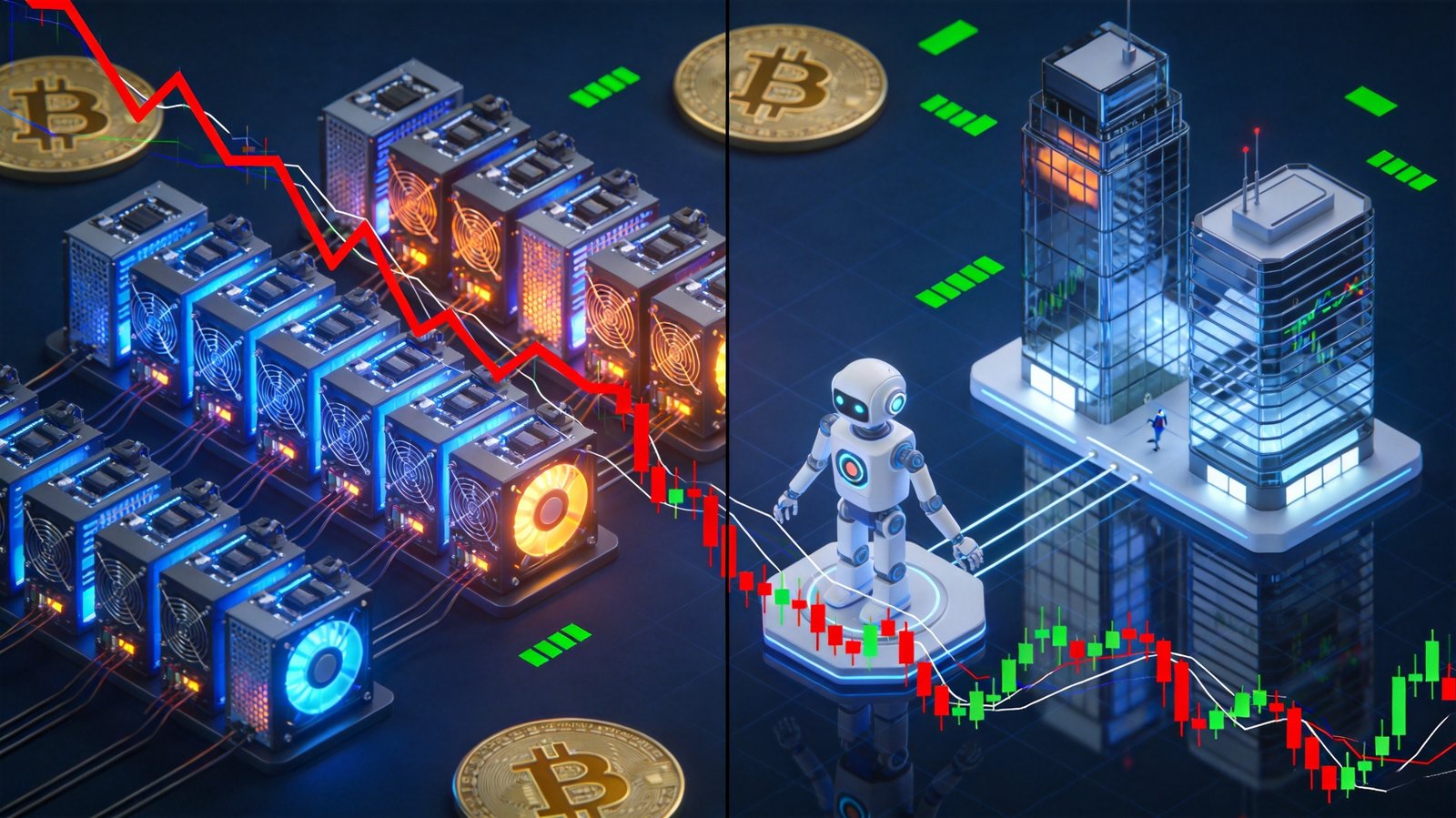
One in Four Bitcoin Miner Models Now Operating at a Daily Loss
Nearly 23% of mainstream ASIC mining rigs are generating negative daily returns after electricity costs, with the estimated network shutdown price sitting at $46,787.
MarsHub News
Published August 8, 2026
The Numbers Behind the Squeeze
According to data from WuBlockchain Data Center released on August 6, 2026, approximately 22.7% of 22 major ASIC mining models were generating negative daily net returns after accounting for electricity costs and current network conditions. This is not a hypothetical scenario or a worst-case projection — it is a real-time snapshot of an industry living on increasingly thin margins.
The data paints a stark picture: even with Bitcoin trading near $64,884, nearly one in four mining rigs is effectively losing money every single day they run. The estimated network-wide shutdown price — the BTC level at which even the most efficient machines break even — sits at approximately $46,787. For older, less efficient hardware, that pain threshold is considerably higher.
What Drives Miners Into the Red
Three converging forces have created this profitability squeeze. First, the network hashrate has stabilized around 921 EH/s, maintaining competitive pressure on individual miners despite having dropped significantly from the October 2025 peak of 1,133 EH/s. Second, mining difficulty remains elevated even after multiple downward adjustments, keeping the bar for profitability high. Third, post-halving block rewards of 3.125 BTC per block mean less revenue flowing to each unit of hashrate.
The economics are straightforward: a miner's profitability depends on the gap between BTC revenue and electricity costs. When Bitcoin trades at $65,000 but hashprice — the revenue per unit of hashrate — remains depressed around $31 per PH/s, only operators with the cheapest electricity survive comfortably. Those paying above $0.06/kWh on older equipment find themselves underwater.
The Cascade Effect: What Happens When Miners Shut Down
When unprofitable miners disconnect, a well-understood mechanical process begins. Network hashrate drops, which triggers Bitcoin's built-in difficulty adjustment — resetting lower approximately every two weeks. This, in turn, reduces the cost to mine per coin for those who remain online, slowly restoring equilibrium.
However, this self-correcting mechanism does not eliminate short-term risks. If Bitcoin slides further and stays below $47,000 for an extended period, the speed of miner exodus could outpace difficulty recalibration, creating a temporary gap where transaction processing slows and mining centralization increases among well-capitalized fleets with access to sub-$0.04/kWh power.
Hedging Complicates the Picture
The 22.7% figure, while alarming, does not tell the complete story. Many operators use derivatives or Bitcoin-backed loans to smooth cash flows, buying time even when daily returns turn negative. Large-scale miners have also locked in power purchase agreements, meaning their actual breakeven may differ significantly from generic estimates.
This means the reported unprofitability percentage is a warning light rather than a death sentence. However, it strips away any narrative that all major operators are comfortably profitable at current spot prices. A significant segment is not, and the market is acutely aware of the price level at which deeper problems begin.
Strategic Implications for Hardware Buyers
For operators evaluating hardware upgrades, the current environment creates a critical decision point. Next-generation machines like the Antminer S21 series at sub-20 J/TH efficiency offer a significant survival advantage over previous-generation equipment running at 30+ J/TH. The gap between profitable and unprofitable rigs increasingly maps onto the generational divide in hardware efficiency.
Professional hosting at competitive electricity rates becomes even more crucial in this environment. The difference between $0.04/kWh and $0.07/kWh can mean the gap between profitability and loss for marginally efficient hardware. Operators running fleets of mixed-generation equipment face the hardest calculus: which machines to keep running and which to retire.
The AI pivot continues to reshape the competitive landscape. Public miners like Cipher Mining and TeraWulf are reallocating power capacity toward AI and high-performance computing, recognizing that Bitcoin mining alone may not sustain valuations if hashprice stays depressed. For traditional miners, this means competing for power against tenants willing to pay significantly more per kilowatt-hour.
Key Levels to Watch
The path of Bitcoin's price will determine whether this data point becomes a footnote or a catalyst. Above $48,000, most top-tier miners stay in the green, and the network hums along without major disruption. Below $46,500, the conversation shifts from "miner profitability" to "miner surrender" — a phase historically linked to local price bottoms. Between these levels, the market watches whether marginally unprofitable units actually stop hashing and whether their operators choose to sell mined inventory instead of waiting.
Bitcoin currently trades around $64,884 with a Fear & Greed Index at 29 (Fear), suggesting cautious sentiment. The network hashrate stands at 921.4 EH/s with a 30-day realized volatility of 29%. For miners, the imperative is clear: upgrade to efficient hardware, secure low-cost electricity, and prepare for continued margin compression through the remainder of 2026.
MarsHub is a leading one-stop miner sales and mining farm hosting platform. We provide top brands including BITMAIN Antminer S21, S21+ and MicroBT WhatsMiner series, with global shipping and 24/7 professional hosting. For bulk miner orders, hosting inquiries, or custom deployment plans, reach out to our team for competitive rates.
This article is provided for informational purposes only and does not constitute investment advice. Always conduct your own research before making any financial decisions.
Optimize Your Mining Operation
MarsHub provides next-generation ASIC miners and professional hosting services to maximize your mining profitability even in compressed margin environments.